Hydraulic Manifold Blocks for Aerospace: Why Internal Channel Finish and Deburring Are as Important as the Bore Diameter
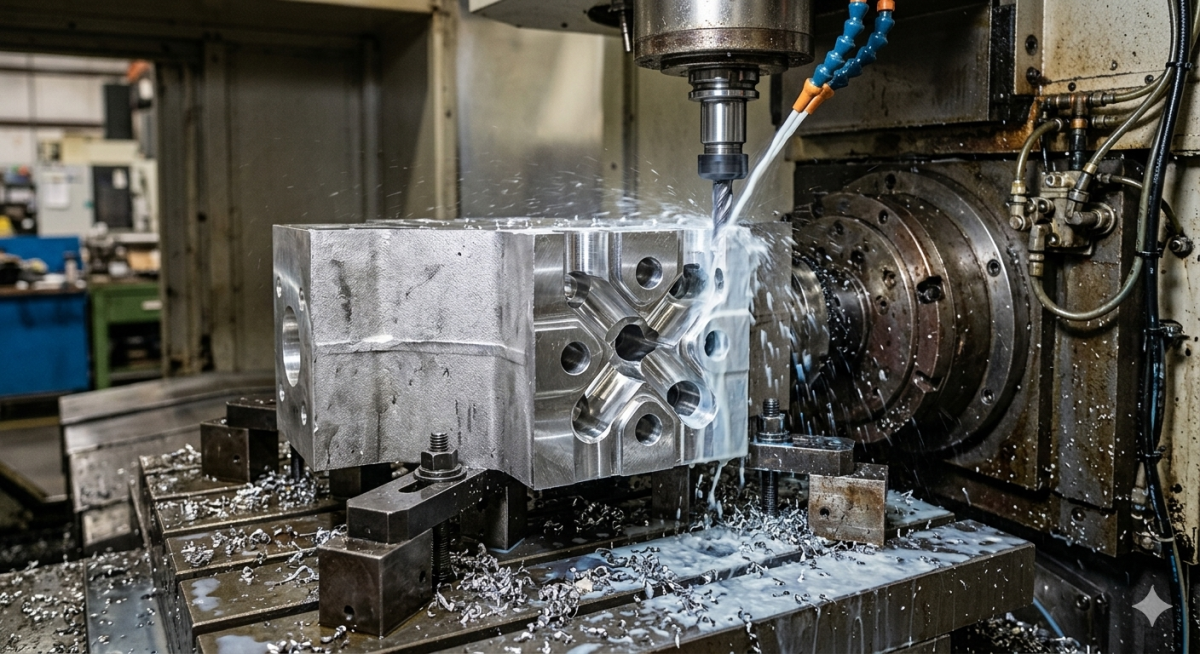
Aerospace hydraulic manifolds can carry demanding dimensional, cleanliness, surface-finish, and traceability requirements. Bore diameter is important, but the applicable tolerance must come from the approved drawing and system requirements. Internal channel condition, intersecting-hole deburring, material control, inspection, and validation can be equally important to reliable performance.
For aerospace applications, a perfect bore diameter is meaningless if the internal channel finish and cross-hole deburring are compromised. Here is why the internal topography of a manifold block is just as critical as its dimensional accuracy.
1. Fluid Dynamics and the Threat of Pressure Drops
Hydraulic manifolds direct fluid through networks of internal channels. Surface roughness, abrupt transitions, poorly blended intersections, and channel geometry can influence pressure loss and flow behaviour. Operating pressure and acceptable internal finish vary by system, so requirements should be defined by the responsible engineering authority rather than assumed from a general pressure range.
Excessive restriction or disturbed flow can contribute to pressure loss, heat generation, noise, or reduced system response. Manufacturers should therefore control the features identified as critical by the design and verify them using appropriate inspection or validation methods.
2. Cavitation and Component Fatigue
A rough internal finish doesn't just cause turbulence; it can induce cavitation. When fluid rushes over sharp microscopic peaks or poorly blended radii inside the manifold, the localized pressure can drop below the fluid's vapor pressure. This forms vapor bubbles that violently collapse as they move into higher-pressure zones.
Where system conditions create a cavitation risk, repeated bubble collapse can damage internal surfaces over time. Suitable material, geometry, edge condition, surface requirements, and system validation can help reduce that risk, but machining quality alone cannot guarantee manifold fatigue life.
3. The Hidden Danger of Cross-Hole Burrs
Manifold blocks commonly contain intersecting drilled or machined channels. These operations can create burrs at internal intersections. A loose burr may become foreign object debris and interfere with valves, seals, filters, or other hydraulic components, making controlled deburring and cleanliness verification important.
If a burr breaks off during flight operations due to high-pressure fluid cycling, it becomes Foreign Object Debris (FOD) within a closed system. A single microscopic metal chip can travel through the fluid and jam a spool valve, score a cylinder wall, or clog a servo filter.
Advanced Deburring and Finishing Methodologies
Manual deburring may be unsuitable for some blind or inaccessible intersections. Depending on geometry, material, specification, and customer approval, manufacturers may evaluate controlled mechanical tools, abrasive-flow processing, thermal deburring, electrochemical methods, or another validated process:
- Abrasive Flow Machining (AFM): Pumping a viscoelastic abrasive polymer through the manifold channels to uniformly polish internal surfaces and softly radius intersecting holes.
- Thermal Energy Method (TEM): Utilizing a controlled, instantaneous combustible gas flash to vaporize burrs at the microscopic level without altering the block's core dimensions.
- Specialized CNC Deburring Tools: Utilizing multi-axis CNC capabilities with automated undercutting and orbital deburring tools to chamfer internal intersections dynamically during the primary machining cycle.
The Bottom Line
When evaluating a supplier for aerospace hydraulic manifolds, confirm more than the reported bore diameter. Review internal-edge requirements, cleaning controls, inspection access, special-process approvals, material traceability, nonconformance control, and objective evidence that the selected process meets the drawing and contractual requirements.
Origin Basis is establishing its Greater Noida facility for a planned April 2027 production opening. Origin Basis is not currently AS9100 certified. Future aerospace enquiries will be accepted only after reviewing the drawing, certification requirements, special processes, traceability, inspection scope, equipment suitability, capacity, and customer approvals.