Precision CNC Machining for Medical Device Manufacturers: Tolerances, Traceability, and Verification Guide
Medical-device manufacturing can involve stringent quality, regulatory, documentation, and risk-management requirements. Depending on the component and its intended use, an out-of-tolerance feature or an untraceable material lot may create product-performance, regulatory, or patient-safety risks. The applicable controls must be defined by the legal manufacturer and the approved technical requirements.
For medical device Original Equipment Manufacturers (OEMs), choosing a precision CNC machining partner requires evaluating capabilities far beyond standard machine shop operations. It demands an intricate understanding of micro-tolerances, absolute material integrity, and strict process validation.
This technical guide reviews important sourcing considerations for medical-device CNC machining: part-specific tolerances, material and process traceability, inspection evidence, supplier qualification, and clearly assigned validation responsibilities.
The Reality of Medical-Grade Tolerances: Beyond Standard Machining
Medical devices often require complex geometries packed into exceptionally small profiles. Achieving the necessary fit, form, and function means moving past standard commercial tolerances (±0.1 mm) into the realm of micro-precision.
Linear and Geometric Tolerances
Some advanced surgical, diagnostic, or implantable-device components may include linear tolerances near ±0.005 mm, but this is not a universal medical tolerance and may not be achievable on every geometry, material, machine, or feature. Geometric Dimensioning and Tolerancing (GD&T) should communicate the functional relationships that must be controlled. Buyers should require a part-specific capability and measurement review before ordering:
- Cylindricity and Concentricity: Crucial for sliding valves, bone screw threads, and rotating components in surgical drills to prevent binding or premature wear.
- True Position: Essential for multi-component assemblies where mating parts must align flawlessly without introducing structural stress.
Surface Finish and Ra Values
In medical manufacturing, surface finish is a structural and biological requirement, not just an aesthetic one. For implants, an incorrect surface finish can impede osseointegration or cause tissue irritation. For fluidic diagnostic devices, microscopic burrs or rough surfaces can disrupt fluid dynamics or trap bacteria.
- Surface finish: Requirements such as Ra 0.4 µm may apply to particular features, but the appropriate value depends on function, material, machining access, finishing, cleaning, and validation. The supplier should confirm the proposed process and measurement method for each specified surface.
Material Behavior Under the Spindle
Maintaining these tolerances requires deep expertise in handling medical-grade materials, each presenting unique machining characteristics:
- Titanium Grade 5 (Ti-6Al-4V): Highly favored for biocompatibility but notorious for its low thermal conductivity and high work-hardening rate, requiring rigid setups and precise chip control.
- PEEK (Polyetheretherketone): An excellent radiolucent polymer that offers high strength but is prone to thermal expansion and stress cracking if fed incorrectly or subjected to improper cutting temperatures.
- 316L Medical-Grade Stainless Steel: Provides excellent corrosion resistance but demands sharp tooling and optimized feeds to prevent surface glazing.
Ironclad Traceability: Meeting ISO 13485 Standards
Traceability can be a critical part of medical-device manufacturing. The required depth may include material lot, manufacturing route, inspection, special processes, personnel, equipment, and release records. The legal manufacturer should define the applicable regulatory and contractual requirements, while the machining supplier must demonstrate how those records will be controlled.
Material Test Reports (MTRs) and Mill Certificates
Where required, incoming material should be obtained from an approved source and accompanied by the specified certification or test report. The purchasing specification should define the required grade, condition, standard, heat or lot identification, and any additional testing needed. Documentation should be reviewed for completeness and linked to the applicable production records.
Heat Lot Traceability
A controlled routing and identification system can maintain linkage between material lots and the components produced from them. If a material concern is later identified, accurate records can support targeted containment and investigation. The effectiveness of this system should be verified through records and audit evidence rather than assumed.
Inspection and Metrology Documentation
Inspection evidence should be appropriate to the feature, tolerance, risk, and contractual requirement. Before ordering, agree which dimensional reports, certificates, sampling plans, measuring methods, and calibration records must be provided. Relevant equipment may include:
- CMM (Coordinate Measuring Machine) Reports: Providing point-cloud or tactile dimensional verification of intricate geometric features.
- Optical Comparators and Digital Microscopes: For non-contact inspection of fragile edges, micro-features, and micro-burr detection.
Critical Checklist: What to Verify Before You Place the Order
Before signing off on a purchase order and launching a production run, medical device engineers and procurement professionals should thoroughly vet the machining vendor across four critical areas:
1. Quality Management System (QMS) Alignment
Confirm which quality-system certification is contractually required and verify its validity, issuing body, site address, and scope. ISO 9001 provides a general quality-management framework, while ISO 13485 addresses quality-management requirements for organizations involved in medical devices. Certification is important evidence, but it does not by itself prove capability for a specific component or transfer the legal manufacturer’s design-control and regulatory responsibilities to the machining supplier.
2. Process Validation (IQ / OQ / PQ)
For high-volume or highly critical medical components, ask if the vendor can support or execute formal process validation:
- Installation Qualification (IQ): Proving the machining equipment is installed and configured correctly.
- Operational Qualification (OQ): Verifying the process operates as intended across the entire expected operating window.
- Performance Qualification (PQ): Demonstrating that the process consistently produces compliant parts under actual production conditions over time.
3. Tooling and Machining Capacity
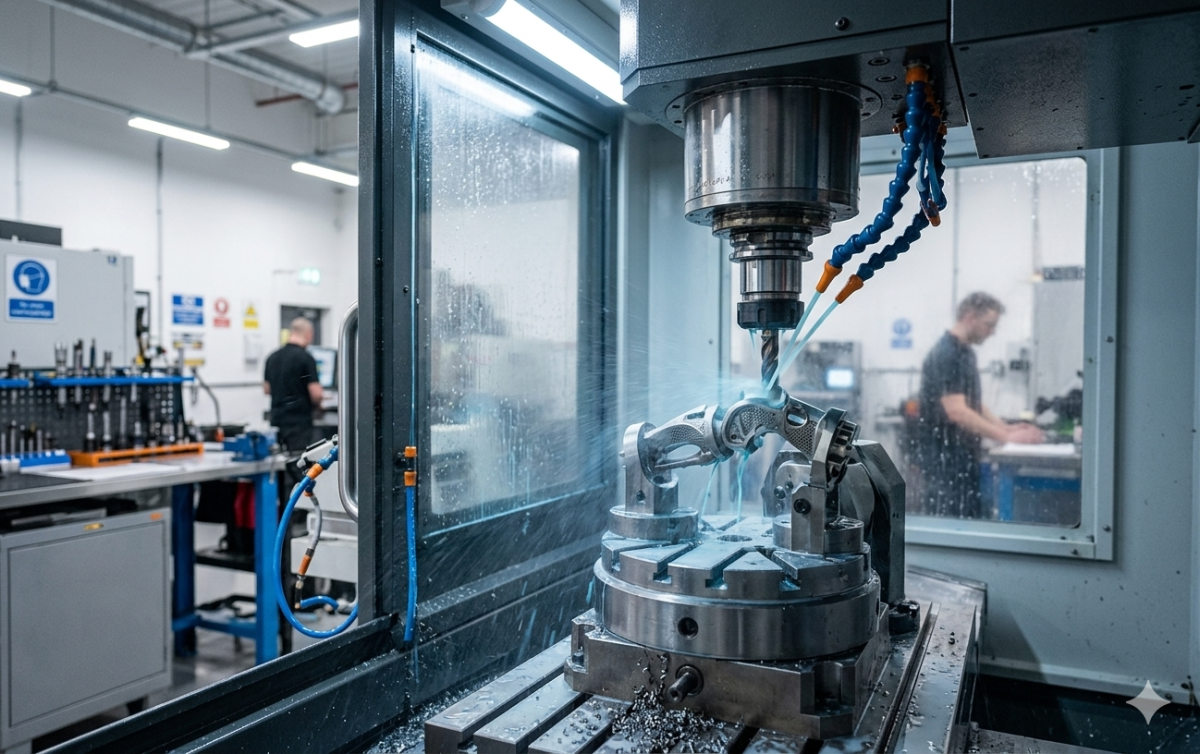
Verify that the supplier’s machines, work envelope, workholding, tooling, programming, and inspection methods suit the actual geometry. Some components may benefit from 4-axis, 5-axis, Swiss-type turning, or another specialized process, but multi-axis equipment does not automatically eliminate error. Datum strategy, fixture qualification, probing, process control, and inspection remain essential when one or multiple setups are used.
4. Post-Machining Cleaning and Deburring Capabilities
Cleanliness, residue, bioburden, particulate, and burr requirements should be defined for the component and its stage of manufacture. Ask how the supplier controls cutting-fluid residue, cleaning, drying, handling, packaging, edge condition, and inspection. Specialized cleaning or controlled environments should be required only where the approved specification and risk assessment call for them.
Conclusion: Securing a Partnership Built on Precision
Precision CNC machining for medical devices is a collaborative engineering effort. Early agreement on tolerances, material sources, traceability, validation responsibilities, cleanliness, inspection evidence, and change control can reduce sourcing risk and support an efficient transition into production. No supplier should guarantee clinical performance or regulatory compliance solely from a general machining-capability statement.
When vetting your next manufacturing campaign, prioritize technical transparency and a proven track record in high-fidelity execution.