Beyond the Grade: Why Material Traceability is Non-Negotiable in Aerospace & Medical Machining
In high-precision manufacturing, the difference between a successful component and a catastrophic failure often starts before the machine even turns on. It starts with the raw material.
For industries like aerospace and medical devices, "Aluminum" is never just aluminum. It is a strictly controlled alloy that must be accompanied by a transparent paper trail. If you are a buyer or an engineer, understanding the difference between "Commercial Grade" and "Certified Grade" is the first step in risk mitigation.
The "Local Dealer" Trap: Why Batch Numbers Matter
Many local material dealers operate in the general commercial market. They may sell you a plate of Aluminum 6061-T6, but they often cannot answer the most critical question: Which specific batch or "heat" did this come from?
In a general workshop, this might not matter. But in aerospace or medical sectors, a lack of traceability is a non-starter.
- The Problem: Without a recorded Lot or Batch Number, you have no proof of the material's chemical composition or mechanical properties.
- The Risk: If a component fails in the field, the inability to trace that material back to the mill creates a "liability black hole." Regulatory bodies like the FAA or FDA require that every single gram of metal be accounted for from the furnace to the finished part.
The Power of the Mill Test Report (MTR)
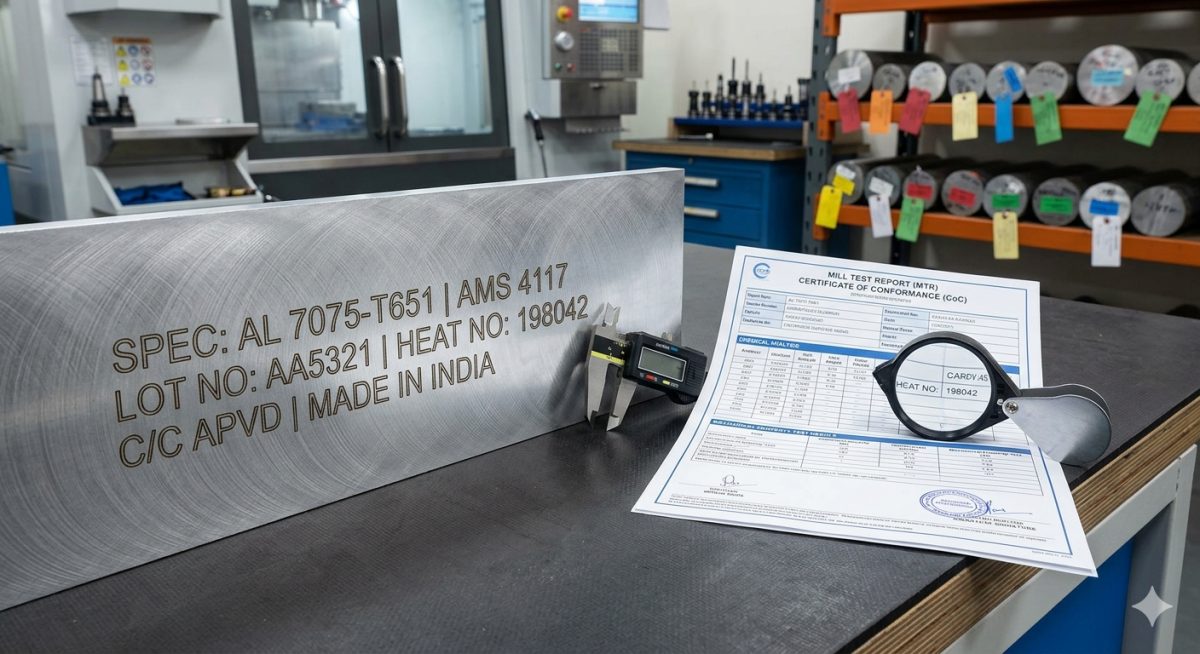
The gold standard for material verification is the Mill Test Report (MTR). This is essentially the "birth certificate" of the metal. A proper MTR provides:
- Chemical Analysis: Exact percentages of alloying elements (Chromium, Magnesium, etc.).
- Physical Properties: Tensile strength, yield strength, and elongation.
- Heat Number: The unique identifier for the specific melt of metal.
If a vendor cannot provide an MTR that matches the stamp on the material, it is not aerospace-grade material—it is a liability.
Navigating the Sourcing Landscape
To ensure quality, procurement must follow a strict protocol:
1. Use Approved Vendor Lists (AVL)
Professional machine shops do not buy from unknown sources. They maintain an Approved Vendor List. These are suppliers who have been audited to ensure they maintain their own quality systems (such as ISO 9001 or AS9120).
2. Verification Upon Receipt
The protocol doesn't end at the purchase. When material arrives, the shop must:
- Verify the Heat Number on the metal matches the MTR.
- Check for physical damage or "inclusions" in the metal.
- Log the material into a digital tracking system before it ever touches a CNC machine.
3. Standard-Specific Requirements
- Aerospace (AS9100 Standards): Focuses heavily on the prevention of "Counterfeit Parts" and ensuring the material can withstand extreme flight stresses.
- Medical (ISO 13485 Standards): Focuses on biocompatibility and ensuring the material won't react negatively when in contact with the human body or surgical environments.
Conclusion: Trust is Built on Paper
The cost of certified material from an approved vendor is higher than "off-the-shelf" local aluminum. However, that price difference is an investment in insurance.
In the world of precision engineering, the goal is not just to make a part—it is to make a part that is guaranteed to perform. By insisting on batch-specific traceability and certified vendors, manufacturers protect their clients, their reputation, and, most importantly, the end-users of the technology.
About Origin Basis We are currently developing our precision manufacturing framework in Greater Noida, focusing on the rigorous quality standards required for the next generation of aerospace and medical components. Our mission is to bridge the gap between engineering design and certified material reality.