Precision Machining for EV Motor Housings: Overcoming Manufacturing Challenges
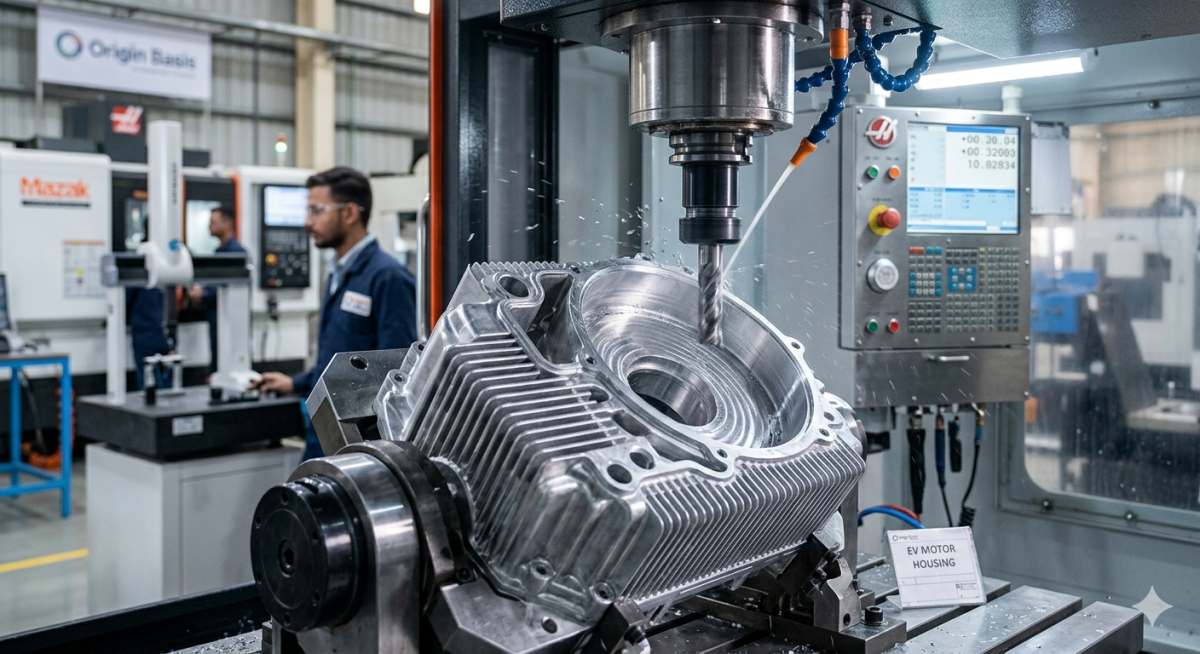
The electric vehicle (EV) revolution is rapidly transforming the automotive industry, and at the heart of every EV is its electric motor. Protecting and optimizing this critical component is the EV motor housing. Far more than just a simple enclosure, the motor housing is a highly engineered, precision-machined component responsible for thermal management, structural integrity, and noise reduction.
Manufacturing these housings presents unique challenges. As the industry pushes for lighter, more efficient, and more powerful vehicles, the demands placed on CNC machining processes are higher than ever.
Here is a look at the core manufacturing challenges in precision machining for EV motor housings and how top-tier manufacturing partners overcome them.
Why Precision is Non-Negotiable for EV Motor Housings
In traditional internal combustion engines, certain tolerances could be slightly forgiving. In an electric motor, however, the gap between the rotor and the stator is incredibly small—often measured in fractions of a millimeter. If the motor housing is not machined to exact specifications, it can lead to:
- Poor NVH (Noise, Vibration, and Harshness): Misalignment causes vibrations, leading to loud, inefficient, and uncomfortable rides.
- Thermal Failure: EV motors generate immense heat. Housings typically contain complex, integrated cooling jackets. Imperfect sealing surfaces or misaligned coolant channels can lead to catastrophic motor failure.
- Reduced Efficiency: Even minor deviations in concentricity can cause electromagnetic imbalances, draining the battery faster and reducing the vehicle's range.
Key Manufacturing Challenges in CNC Machining EV Housings
1. Complex Geometries and Thin-Walled Structures
To offset the heavy weight of EV batteries, motor housings are typically cast from lightweight aluminum alloys and designed with extremely thin walls. While great for the vehicle's overall weight, thin walls are prone to distortion, vibration, and chatter during the CNC machining process.
The Solution: Machining these geometries requires specialized workholding solutions to support the thin walls without applying excessive clamping force that could warp the part. Advanced CAM software is utilized to optimize tool paths, reducing cutting forces and preventing deformation.
2. Achieving Extreme Concentricity and Cylindricity
The internal bores that hold the stator and bearings must be perfectly aligned. Maintaining extreme concentricity across a large aluminum housing is notoriously difficult, especially when moving the part between different machines or setups.
Manufacturing approach: Depending on the housing geometry, machine configuration, and access requirements, 4-axis or 5-axis machining can reduce repositioning and help control relationships between critical features. A single setup is not always possible, so datum strategy, qualified fixtures, probing, and verification between operations remain important.
3. Surface Finish for Coolant Sealing
EV motor housings may include integrated cooling jackets and sealed mating surfaces. Surface-finish, flatness, waviness, and sealing requirements must come from the approved design and sealing validation. A value such as Ra 0.8 may be specified for some applications, but it is not a universal requirement for every housing or sealing system.
Manufacturing approach: Surface quality on cast aluminum depends on casting condition, machine rigidity, tool geometry, insert material, cutting parameters, chip control, fixturing, and finishing strategy. The process should target the drawing requirement and functional sealing need rather than an undefined “mirror-like” appearance.
4. Managing Thermal Expansion During Machining
Aluminum has a high coefficient of thermal expansion. The friction generated during aggressive roughing cuts can actually heat the housing enough to expand it. If a machinist performs the final finishing passes while the part is hot, the housing will shrink once it cools, resulting in undersized bores and rejected parts.
Manufacturing approach: Thermal effects should be considered during roughing, finishing, and inspection. Appropriate coolant control, planned stabilization time, temperature-aware measurement, and compensation may be required depending on tolerance, part size, material condition, and production environment. A climate-controlled machining room is not automatically required for every component.
Partnering for EV Manufacturing Success
As EV technology continues to advance, the margin for error in component manufacturing continues to shrink. Successfully producing EV motor housings requires a manufacturing partner that understands not just how to run a CNC machine, but how to engineer a complete, stable manufacturing process.
Origin Basis is currently establishing its Greater Noida facility for a planned April 2027 production opening. Our planned scope includes 3-axis and 4-axis CNC machining and part-specific inspection planning. Future EV motor-housing enquiries will be evaluated against available equipment, casting condition, datum strategy, tolerance requirements, metrology, process validation, capacity, and customer-specific quality requirements before any commitment is made.
Are you developing components for the next generation of electric vehicles? Contact us to submit an advance enquiry. We can review the drawing and requirements before launch, while manufacturing feasibility, timing, inspection scope, and production commitments will be confirmed after commissioning and technical validation.