Why Aluminum Alloy Selection Is the First Decision That Determines Machining Success
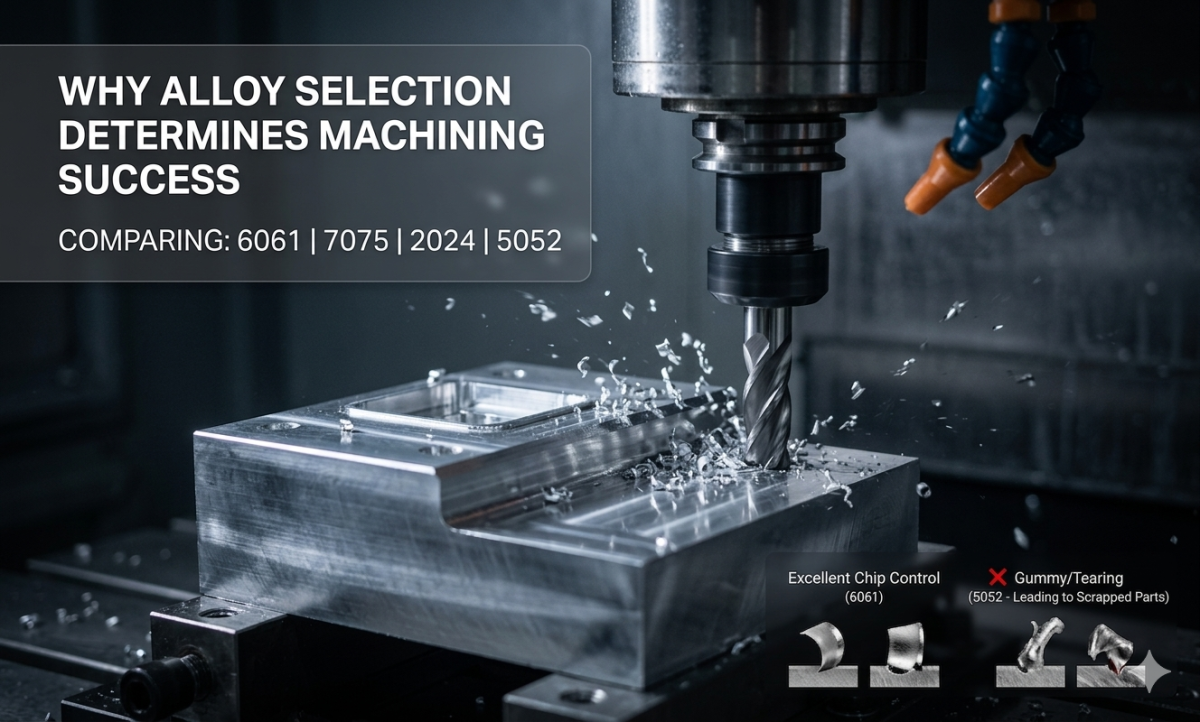
In precision manufacturing, success is often determined before the first chip is even cut. While CAM programming, toolpaths, and rigid workholding are essential, specifying the wrong raw material can doom a project from the start. Aluminum is universally praised for its machinability, but treating all aluminum alloys as interchangeable is a costly mistake.
The differences between 6061, 7075, 2024, and 5052 dictate chip formation, tool wear, thermal stability, and ultimate part geometry. Here is a breakdown of when to use each, their machinability profiles, and the consequences of choosing the wrong alloy.
1. Aluminum 6061-T6: The Industry Workhorse
If there is a default alloy in CNC machining, it is 6061. Magnesium and silicon are its primary alloying elements, offering an excellent balance of strength, corrosion resistance, and weldability.
- Machinability: Excellent. It produces predictable, manageable chips when machined with proper speeds and feeds.
- When to Use: General-purpose machining, brackets, structural frames, and complex components that require secondary operations like welding or anodizing.
- The Trap: Because it is so versatile, designers sometimes over-specify it for high-stress applications where a stronger alloy is necessary, leading to premature mechanical failure in the field.
2. Aluminum 7075-T6: The Heavyweight
When strength-to-weight ratio is the absolute priority, 7075 is the standard. Alloyed with zinc, it boasts a tensile strength comparable to many steel grades while maintaining aluminum's lightweight footprint.
- Machinability: Fair to Good. It is harder than 6061, which actually results in an exceptional surface finish during milling and turning. However, this hardness increases tool wear and requires more rigid setups.
- When to Use: Aerospace components, high-stress structural parts, and demanding automotive applications like EV motor housings where material integrity under immense rotational force is non-negotiable.
- The Trap: 7075 is notoriously difficult to weld and is prone to stress-corrosion cracking. Specifying 7075 for a welded assembly will result in severe cracking and scrapped components.
3. Aluminum 2024-T3: The Fatigue Fighter
Alloyed primarily with copper, 2024 is engineered for high fatigue resistance. It can withstand cyclical loading far better than 6061.
- Machinability: Good. The copper content makes it slightly "gummier" than 7075, but it still machines well and yields a fine finish.
- When to Use: Aircraft structures, clock parts, tension members, and any component subjected to constant repetitive stress.
- The Trap: The high copper content that gives 2024 its fatigue strength also makes its corrosion resistance terrible. If you specify 2024 for an exposed environmental application without a protective cladding or coating, it will rapidly degrade.
4. Aluminum 5052-H32: The Sheet Metal Specialist
5052 is alloyed with magnesium. It is exceptional for sheet metal work, bending, and forming because of its high ductility.
- Machinability: Poor. This is where many designers make a critical error. 5052 is incredibly gummy. Instead of shearing cleanly, the material tends to tear and weld itself to the cutting tool (Built-Up Edge).
- When to Use: Sheet metal enclosures, fuel tanks, and stamped parts.
- The Trap: Specifying 5052 for heavy milling or turning operations is a nightmare for machinists. Chip control is nearly impossible, surface finishes are often terrible, and the localized heat from machining can cause severe warping.
How the Wrong Choice Leads to Scrapped Parts
A scrapped part isn't always obvious while it's still in the machine enclosure. Often, the failure only becomes apparent when the part reaches the granite surface plate, and an actively engaged micrometer reveals that the dimensions have drifted.
Choosing the wrong alloy leads to scrapping parts in three primary ways:
- Material Warpage: Machining induces internal stresses. In demanding applications like thin-wall aluminum enclosures, cutting into a gummy or incorrectly tempered alloy releases these stresses unevenly. The part will twist or bow out of tolerance the moment it is released from the vise.
- Tool Deflection and Breakage: Gummy alloys like 5052 can cause a cutter to grab the material rather than slice it, pulling the tool off its programmed path and destroying the part's dimensional accuracy.
- Functional Risk: A component may look acceptable and pass dimensional inspection but still underperform if the selected alloy does not provide the strength, corrosion resistance, fatigue behaviour, temperature capability, or other properties required by the approved design. Material substitution should therefore receive authorized engineering approval.
Successful manufacturing planning begins with the approved material specification. Origin Basis is establishing its Greater Noida facility for a planned April 2027 production opening. Future enquiries can include a manufacturability discussion about machining behaviour, but final material selection and design approval remain with the customer’s authorized engineering function. Submit an advance enquiry to discuss a future component.